MarketingSecrets.AI Review: I Paid $2,997 For It (What I Actually Got)
Most Marketing Secrets AI reviews are written by people who signed up for the free trial, clicked around for an afternoon, and rebuilt the rest from the sales page. I'm in a different position. I attended the AI Secrets Challenge in late April on a free ticket, and by day 4 I'd paid $2,997 for the Platinum package. This is what that money actually bought, what I still open every week, what I quietly abandoned, and what I'd do differently if I could rewind to April.
Fair warning before you read on: I'm not neutral. I bought the thing. But I'd rather give you the awkward details than pretend I ran a controlled experiment.
How I ended up buying it
Some background so you can weigh my bias properly. I run affiliate campaigns and content sites, so I registered for the challenge partly to study how the ClickFunnels team runs these events. Professional curiosity. I went in fully expecting to watch the mechanics and walk away with notes.
The challenge ran April 27 to May 1, one long session per day, Russell Brunson plus a rotating cast of ClickFunnels people. Days 1 through 3 are genuinely instructional. They cover how the team uses AI for offer construction, funnel copy and content production, and if you have never systematized any of that, there's real material there. Days 4 and 5 are where the Platinum package gets sold at $2,997.
I knew that structure going in. I bought anyway. Make of that what you will, but it's worth saying plainly: the event does exactly what it was built to do, and being able to see the machinery did not make me immune to it. If anything it made me a more interesting case study for myself.
What Marketing Secrets AI actually is
The shortest honest description: it's a chat-based AI workspace pre-loaded with Russell Brunson's marketing frameworks that remembers your business between sessions.
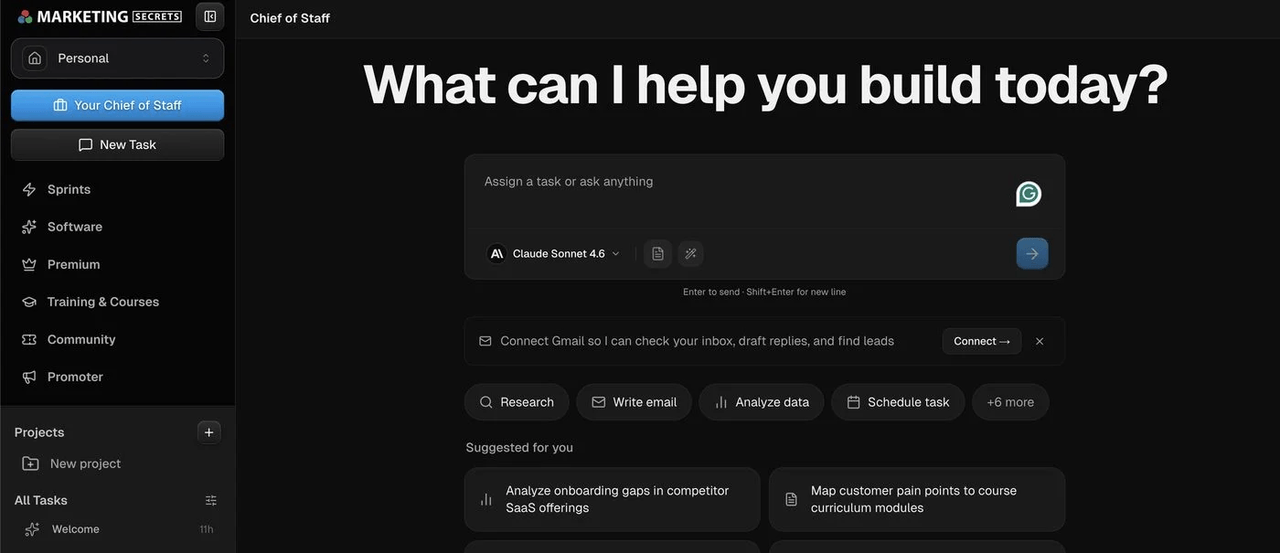
My actual workspace. Worth noting the model selector: it's running Claude underneath, which surprised a few people who assumed otherwise.
That second half is the actual product, and it's the part the sales page undersells. Any general AI tool can write you a headline. The friction with ChatGPT or Claude for marketing work is that every new conversation starts from nothing, so you burn the first ten minutes re-explaining your offer, your customer, your price point and your voice before you get anything usable. Multiply that by every task in a week and it's a meaningful tax.
This platform holds that context permanently. You load your business in once and every tool inside it works from that same picture. They brand this as an AI chief of staff, which is sales language, but the underlying mechanic is real and it's the single reason I still open the app instead of a blank chat window.
What's actually inside
The left sidebar is the honest table of contents: Chief of Staff, Sprints, Software, Premium, Training and Courses, Community, and Promoter.
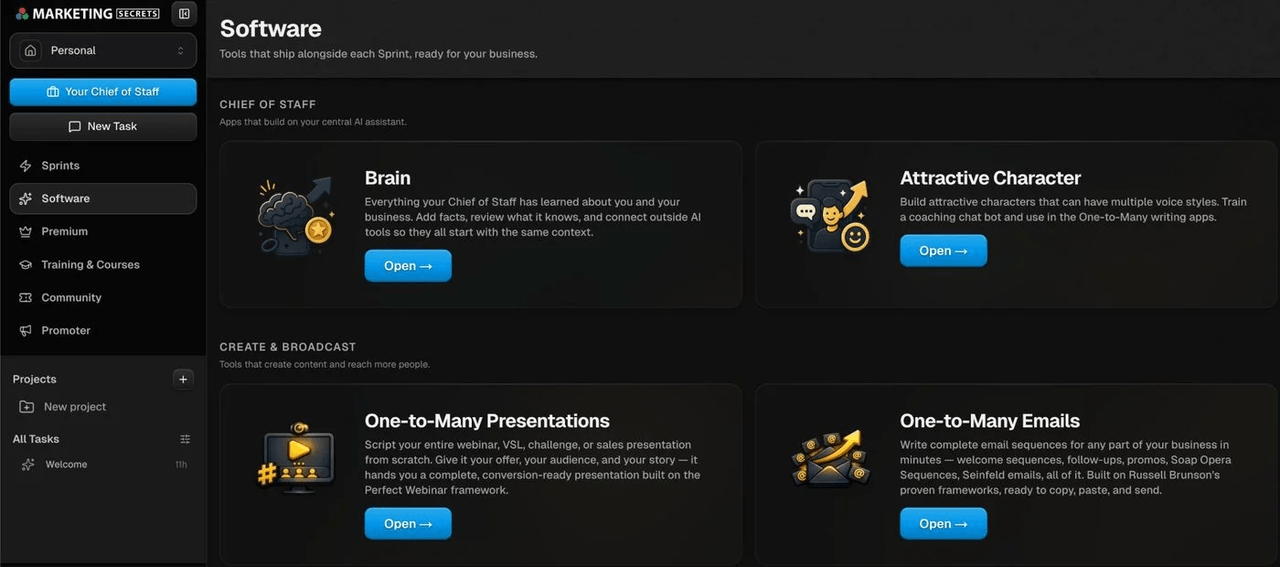
The module grid. Before you price any of this, go through it and subtract the tools you know you'll never open.
The Software section is where most of the day-to-day work happens. There are dedicated tools for building offers, writing funnel copy, planning webinars, running Dream 100 research, and producing content.
Sprints are the more interesting format. They're guided multi-step workflows rather than single prompts, so instead of asking for a headline you walk through building an entire attractive character or offer stack in sequence, with the system holding what you decided at step two when you reach step six. For someone who has read the books but never actually implemented the frameworks, this is the closest thing to being walked through it.
The strategy chat runs those frameworks explicitly. If you've read DotCom Secrets or Expert Secrets you'll recognize the skeleton under every response: hook, story, offer, value ladder, the whole canon. That's a strength if you buy into that school and a hard limitation if you don't.
The pricing structure nobody explains properly
This confused me for a while, and almost every review I've read gets it wrong, so here's how it actually works.
There are two layers. The software itself is a subscription that bills through ClickFunnels at $97 a month and carries a monthly credit allowance. The Platinum package I bought at $2,997 sits on top of that: it's the training library, the challenge recordings, the bonus stack and extended access. It is not a replacement for the software subscription.
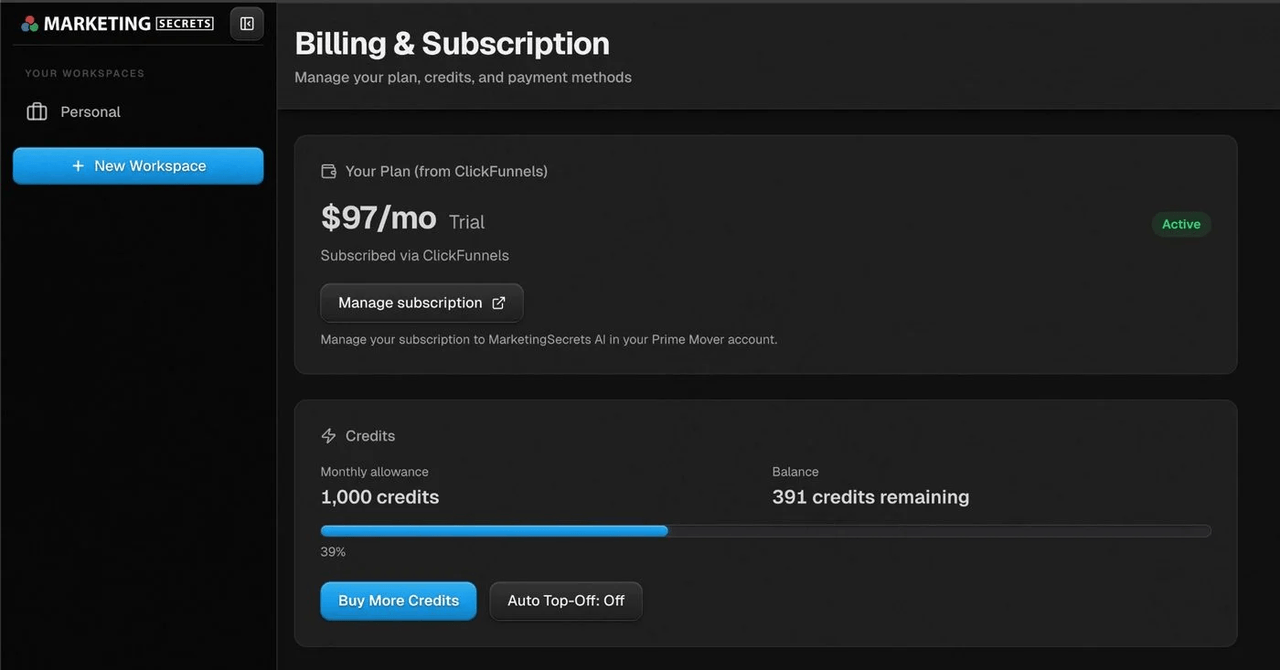
My billing screen: $97 a month through ClickFunnels, entirely separate from the $2,997. If you'd rather sample the teaching before committing to either number, the free event is the cheapest way in.
If you were expecting a single $2,997 payment that covers everything forever, adjust your expectations before you buy rather than after.
Now run the arithmetic that the day-4 presentation does not encourage you to run. $2,997 is roughly 31 months of the $97 plan. The training is good. It is not thirty-one-months-of-software good unless you are deep in the ClickFunnels world and will genuinely finish it.
I want to be fair here, because that framing is slightly unkind. Platinum bundles things the monthly plan doesn't include, and if you attend the events and use the community it isn't only a software question. But nobody presented me that arithmetic on day 4, and I think you deserve to see it before your card comes out.
Credits: the ceiling you'll actually hit
The plan includes 1,000 credits a month. In the screenshot above I'm sitting at 391 remaining, and that's not from anything exotic. Long sprints and heavy content generation move the meter noticeably faster than short chats do.
Nobody mentions this in the reviews I've read, probably because they never used the product hard enough to see it move at all. If you intend to run this as your primary content engine, plan around the allowance or budget for top-ups. It isn't a dealbreaker, just the kind of thing you'd rather learn from a review than from a progress bar sitting at 39 percent on the 20th of the month.
The training library
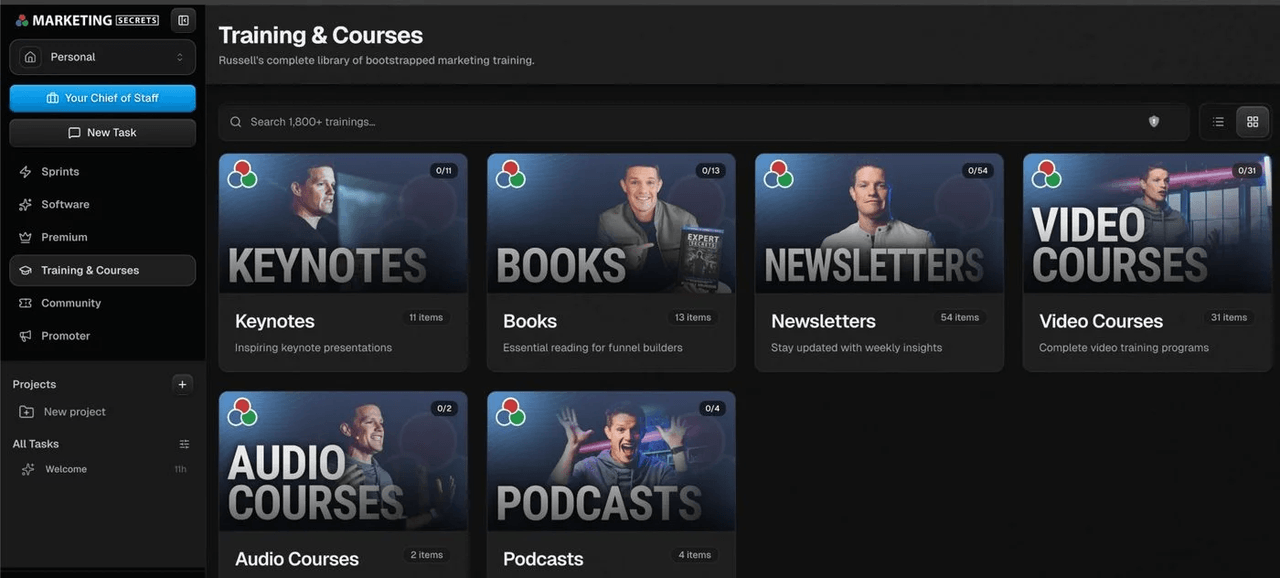
Well past 1,800 trainings. I've watched maybe half of what applies to me, and I doubt I'll finish the rest. The live event covers the same frameworks free if you want to test the teaching style first.
That number gets used as a selling point and I understand why, but volume cuts both ways.
Some of it is genuinely strong, particularly the funnel breakdowns where you watch a real funnel get pulled apart. Some is older ClickFunnels material that has been folded in and shows its age around the edges.
If you're the sort of person who buys courses and completes them, this is the best part of Platinum by a comfortable distance. If you're honest with yourself and know that you won't, don't let the 1,800 number do your deciding for you. A library you don't open is worth zero regardless of what the slide said it was worth.
What I actually use week to week
Here's the part most reviews fudge. I don't use most of the apps. Three things survived into my actual routine.
The business context memory, first and above everything else. This alone is the difference between me keeping the subscription and cancelling it. I feed it campaign data and it drafts angles that already sound like my offer instead of generic marketing mush.
The copy modules for first drafts. Funnel pages and email sequences come out around 70 percent finished. I rewrite the last 30 percent every single time, without exception, but starting at 70 rather than zero is a real saving on a day when I have four things to ship and a deadline.
The Dream 100 research tool, occasionally. It's competent at mapping who already owns the audience I want. I would not pay for it as a standalone product, but as something already sitting in the sidebar I use it more than I expected to.
What I stopped using
The webinar builder, because I don't run webinars. That's a me problem rather than a product flaw, but it's a useful reminder that a meaningful chunk of what you're buying may not apply to your business at all.
Most of the content modules, because the output was too template-shaped for my sites. Once you've seen the pattern three times you start recognizing it in the wild, and I didn't want my pages carrying that fingerprint.
The strategy chat, after I'd internalized the frameworks. It began repeating itself, which is fair enough. There are a finite number of frameworks and once they're in your head you don't need to be walked through them again.
The downsides nobody puts in their review
The output has a house style, and it's a strong one. Everything leans toward Brunson-flavored direct response: urgency, story-selling, stacked offers, curiosity hooks. If you sell to an audience that recoils from that register, you will be fighting the tool on every single draft, and you will lose more of those fights than you expect.
It's also a closed world. The frameworks are ClickFunnels frameworks. For contrarian positioning, or for anything outside that ecosystem, a frontier model with your own carefully built prompts will serve you better and cost you less.
And the training library rewards a discipline most buyers don't have. I include myself in that assessment, which is why I'd tell you to price Platinum on the software and treat the library as a bonus rather than the other way round.
Versus just using ChatGPT or Claude
This is the comparison that actually decides it, so let me be direct about it.
If you're a prompt-savvy operator who has already built a persistent context system, custom instructions, saved projects, a prompt library you maintain and reuse, then you have essentially built this product yourself already. Keep your money.
If you haven't, and re-explaining your business every morning is genuinely costing you time, then the context layer plus the frameworks is a legitimate shortcut. You're paying for someone else to have done the setup work and to have loaded in a marketing methodology that has demonstrably sold a lot of things.
That's the whole value proposition stated flatly. Whether it's worth $97 a month comes down to how many hours it saves you. Whether it's worth an additional $2,997 comes down almost entirely to whether you'll watch the training.
Who should buy and who should skip
Buy it if you sell something online, you already like the Brunson school of marketing, and context-switching between AI tools is costing you real hours every week. The memory plus the copy modules will earn their keep quickly.
Skip it if you don't have an offer yet. The tool amplifies a business, it doesn't invent one, and pointing it at a vague idea produces confident-sounding output about nothing at all.
Skip it if you're allergic to direct-response style, or if you've already built your own context system in ChatGPT or Claude.
And if you're only choosing between the monthly plan and the big package: start monthly. The upgrade offer will still exist later. The countdown timer telling you otherwise is a funnel mechanic, and I say that as someone who bought through one with his eyes open.
Common questions
Is there a free trial? Yes, the software has a trial period before the $97 monthly billing begins. That's the sensible entry point for almost everyone.
Do you need ClickFunnels to use it? The subscription bills through ClickFunnels, as you can see on my billing screen, but the AI workspace is its own product with its own interface.
Is the $2,997 package required? No. The software stands alone on the monthly plan. Platinum is training, recordings and bonuses layered on top of it.
What AI model does it run? Claude, at least in my workspace, which you can see selected in the dashboard screenshot above.
What happens when credits run out? You can buy more or wait for the monthly reset. There's an auto top-off setting, switched off by default in my account.
Can you cancel? The monthly subscription is managed through the Prime Mover account linked from the billing page.
Where to start
Two doors, and I'd take the cheap one first.
If you want to see how this team teaches AI marketing before spending anything, they're running a free online event with Russell and Iman Gadzhi: you can grab a seat here. Same frameworks, same crew, no card required. That's how I got in, and going in free is the version of my story I'd actually recommend repeating.
If you already know you want the software, take the trial into the $97 monthly plan and live in it for two or three months. If the context memory is saving you real hours by then, the bigger package will still be sitting there waiting, and you'll be deciding with your own data instead of a timer on a slide.
Comments